zama-skills
officialAI agent skills for building confidential dApps with the Zama Protocol (fhEVM) — Claude Code plugin + npx fallback
zama-skills
Zama Protocol skill pack for AI coding agents (Claude Code, Cursor, Windsurf, OpenCode, Codex, Aider, Continue) — from an empty directory to a working confidential dApp in 30 minutes.




Built for: Zama Developer Program — Mainnet Season 2 / Bounty Track.
Differentiator: Every code-generating skill (/zama-contract, /zama-test, /zama-frontend, /zama-audit, /zama-debug) queries context7 MCP for live Zama documentation before emitting code — /zama-ai/fhevm (1,772 snippets), /zama-ai/fhevm-hardhat-template, /websites/openzeppelin_confidential-contracts. APIs are checked against current docs, not the model’s training cut-off, so deprecated packages and renamed symbols don’t slip through.
On top of that, /zama-contract refuses 12 forbidden cleartext-leak patterns at generation time — require(FHE.decrypt(x)), if (FHE.decrypt(x)), comparing euint handles with ==/</>, branching on cleartext ebool, decrypting storage slots, and others. The static guard fires even when the user explicitly asks for the pattern, and /zama-audit re-runs the same checks plus ACL-grant verification across the whole repo.
Polished UI out of the box. /zama-frontend reads your contract source, detects the variant (token / voting / wrapper / auction), and materializes a complete Tailwind-styled dApp — connect wallet, network indicator, encrypted-input + reveal panels, transaction status with Etherscan links, dark-mode-ready theme. No more bare <button> placeholders: the panels you ship are the panels the skill writes.
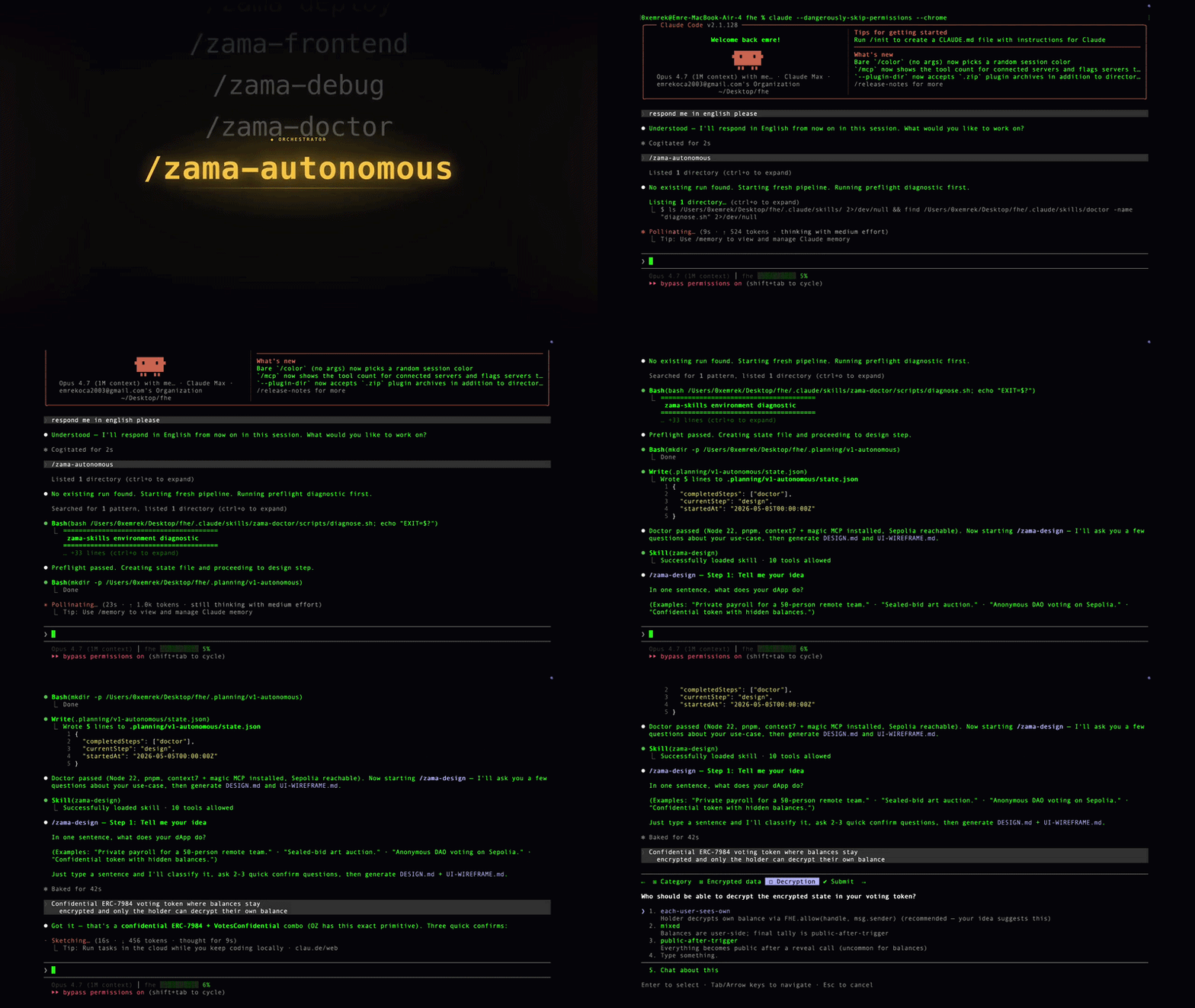
Watch the full video walkthrough (unlisted) · Live dApp on Vercel · Verified contract on Sepolia
Prerequisites
| Tool | Why | Install |
|---|---|---|
| Node.js >= 20 | Runtime for skill scripts | nvm → nvm install 20 |
| pnpm 10+ | Package manager (skill-generated projects use it) | npm install -g pnpm@10 |
context7 MCP | REQUIRED — live Zama / OZ Confidential docs (anti-hallucination) | claude mcp add context7 -- npx -y @upstash/context7-mcp |
magic MCP (21st.dev) | RECOMMENDED — better UI scaffolds for /zama-frontend and /zama-design | claude mcp add magic -- npx -y @21st-dev/magic |
After install, verify with /zama-doctor — it checks every requirement and prints fix commands for whatever is missing.
Install — pick your AI tool
Best experience: Claude Code. This pack was designed around Claude Code’s slash commands, skill auto-routing, and inter-skill chaining (
/zama-design→/zama-init→/zama-contract→/zama-test→/zama-audit→/zama-deploy). The other tools get the same underlying skill content as portable markdown rules — useful, but you orchestrate the chain yourself instead of one slash command kicking off the next.
Click the section that matches your editor / agent.
Don’t see your tool? Pick Generic at the bottom — it drops a self-contained
zama-skills-knowledge/folder you can hand-point any AI agent at.
Claude Code — slash commands, auto-routing, full pipeline (recommended)
Install (one-time)
/plugin marketplace add github.com/kocaemre/zama-skills
/plugin install zama-skills@zama-skills
/zama-doctor                # verifies Node ≥ 20, pnpm, context7 + magic MCP
Optional alternative — install via npm without the marketplace (e.g. global personal install):
npx zama-skills@latest install --tool claude-code             # writes to ./.claude/skills (this project only)
npx zama-skills@latest install --tool claude-code --scope personal   # writes to ~/.claude/skills (every project)
How to use
In any project, just type a slash command — Claude Code picks the next skill from each closing summary:
/zama-autonomous            # one command, full pipeline (design → … → frontend)
/zama-design                # or run skills individually:
/zama-init                  # scaffold pnpm monorepo
/zama-contract              # author confidential .sol with verified ACL
/zama-test                  # mock + Sepolia tests
/zama-audit                 # FHE-aware review (must pass before deploy)
/zama-deploy                # Sepolia + Etherscan verify (manual confirm)
/zama-frontend              # wire @zama-fhe/relayer-sdk
/zama-debug                 # match an FHE error to a fix command
/zama-doctor                # diagnose env at any time
Update / Uninstall
/plugin update zama-skills                                    # marketplace install
npx zama-skills@latest uninstall --tool claude-code --force   # npx install
Cursor — composer + agent rules
Install
cd <your-project>
npx zama-skills@latest install --tool cursor --force
Drops the rule pack at .cursor/rules/zama-skills/. Cursor picks it up automatically — no restart needed.
How to use
Open Composer (⌘+I) or the agent panel and ask in plain English:
“init a confidential token dApp using zama-skills”
“write the confidential transfer logic following the zama-skills contract rules”
“wire the frontend with relayer-sdk per zama-skills/frontend.md”
The zama-skills/README.md inside the rules folder enumerates every skill and the hard rules to enforce.
Uninstall
npx zama-skills@latest uninstall --tool cursor --forceWindsurf — Cascade agent rules
Install
cd <your-project>
npx zama-skills@latest install --tool windsurf --force
Drops the rule pack at .windsurf/rules/zama-skills/. Windsurf’s Cascade agent reads it as project context — no restart needed in most setups.
⚠️ Windsurf has a 12,000-character limit per rule file (source). 8 of our 10 skill files exceed it, so Cascade will silently truncate the long ones. Recommended: also install
--tool genericand tell Cascade “for full rules, seezama-skills-knowledge/<skill>.md” — Windsurf’s rule files then act as the index, and the full content lives outside the 12K-capped folder.
How to use
Open Cascade and ask in plain English:
“init a confidential token dApp using zama-skills”
“write the confidential transfer logic following zama-skills/contract.md”
“wire the frontend with relayer-sdk per zama-skills/frontend.md”
The zama-skills/README.md inside the rules folder enumerates every skill and the hard rules to enforce.
Uninstall
npx zama-skills@latest uninstall --tool windsurf --forceOpenCode — AGENTS.md + per-skill rules
Install
cd <your-project>
npx zama-skills@latest install --tool opencode --force
Drops rules at .opencode/rules/zama-skills/ AND idempotently appends a pointer block to your AGENTS.md so the OpenCode agent picks the rules up automatically.
How to use
Just ask the agent — AGENTS.md directs it to the right skill file:
“follow zama-skills to scaffold a confidential ERC-7984 token”
“write the deploy script per zama-skills/deploy.md”
Uninstall
npx zama-skills@latest uninstall --tool opencode --forceThe AGENTS.md pointer block is stripped automatically; the rest of your file is preserved.
Codex CLI (OpenAI) — AGENTS.md convention
Install
cd <your-project>
npx zama-skills@latest install --tool codex --force
Drops rules at .codex/rules/zama-skills/ and appends an AGENTS.md pointer.
How to use
Codex CLI scans AGENTS.md for project conventions. After install, run any Codex command in this directory and reference the skills by name:
“scaffold a confidential token following zama-skills/init.md”
“audit the contract per zama-skills/audit.md hard rules”
Uninstall
npx zama-skills@latest uninstall --tool codex --forceAider — CONVENTIONS.md auto-load
Install
cd <your-project>
npx zama-skills@latest install --tool aider --force
Drops rules at .aider/zama-skills/ and appends a CONVENTIONS.md pointer block.
How to use
Run aider with --read so it loads the conventions every session:
aider --read CONVENTIONS.mdThen prompt with skill-aware language:
“/ask follow zama-skills/contract.md to add an encrypted transfer”
“implement the deploy script per zama-skills/deploy.md”
Uninstall
npx zama-skills@latest uninstall --tool aider --forceContinue (VS Code / JetBrains) — agent context
Install
cd <your-project>
npx zama-skills@latest install --tool continue --force
Drops rules at .continue/rules/zama-skills/. Restart the Continue panel so it re-reads the rules folder.
How to use
Open the Continue chat and prompt with skill names:
“init a confidential dApp following zama-skills/init.md”
“review this Solidity per zama-skills/audit.md”
Uninstall
npx zama-skills@latest uninstall --tool continue --forceAny other AI tool (Generic) — portable knowledge pack
Install
cd <your-project>
npx zama-skills@latest install --tool generic --force
Drops a self-contained folder at zama-skills-knowledge/ with one markdown file per skill plus a README.md enumerating the hard rules. Works with any AI tool that can read project files (Codeium, JetBrains AI, custom agents, etc.).
How to use
Tell your AI agent (in its system prompt or rules config):
“Read
zama-skills-knowledge/README.mdand the per-skill files under that folder. Follow the Hard rules section verbatim when writing fhEVM code.”
Uninstall
npx zama-skills@latest uninstall --tool generic --force🔥 Install for several tools at once (or all, non-interactive CI)
# Interactive multi-select picker (Claude Code is auto-pre-selected)
npx zama-skills@latest install

# Specific tools
npx zama-skills@latest install --tool claude-code,cursor,opencode --force

# Every supported tool (CI-friendly)
npx zama-skills@latest install --all --force
The interactive picker auto-detects which tools you already use (.claude/, .cursor/, AGENTS.md, .aider.conf.yml, etc.) and pre-selects them.
Re-running
installis idempotent — it’s safe to run any time you want to refresh your local copy after azama-skillsrelease.
Where do the rules go? (project vs global scope)
--scope project (default) writes under cwd — the rules ship with your repo, your team gets them on git pull. This is the right choice for almost every tool.
--scope personal writes under $HOME — only Claude Code actually reads global rules from ~/.claude/skills/. The other tools key off the current working directory.
| Tool | Default location (--scope project) | --scope personal works? |
|---|---|---|
| Claude Code | <cwd>/.claude/skills/zama-skills/ | ✅ yes — ~/.claude/skills/ is real |
| Cursor | <cwd>/.cursor/rules/zama-skills/ | ❌ project-local only |
| Windsurf | <cwd>/.windsurf/rules/zama-skills/ | ❌ project-local only |
| OpenCode | <cwd>/.opencode/rules/zama-skills/ + <cwd>/AGENTS.md | ❌ project-local only |
| Codex CLI | <cwd>/.codex/rules/zama-skills/ + <cwd>/AGENTS.md | ❌ project-local only |
| Aider | <cwd>/.aider/zama-skills/ + <cwd>/CONVENTIONS.md | ❌ project-local only |
| Continue | <cwd>/.continue/rules/zama-skills/ | ❌ project-local only |
| Generic | <cwd>/zama-skills-knowledge/ | ✅ either works (you wire it up) |
The CLI prints a warning if you pick --scope personal for a tool that won’t honor it. Recommended: keep the default --scope project, commit the rule files to your repo, and let your team’s AI agents pick them up automatically.
Demo
The full walkthrough lives at the top of this README — GIF + video + live dApp + verified contract.
Pipeline shown: /plugin marketplace add → /zama-design → /zama-init → /zama-contract → /zama-deploy (live Sepolia) → MetaMask decrypt on the live dApp.
Quick Start — pick your path
After installing the plugin, jump straight to the path that matches your goal. Each path is a chain of skills; Claude Code picks the next one automatically from the closing summary, but you can also type the slash commands yourself.
Path 0 — One command, the whole thing (~30 min, recommended for first-timers)
/zama-autonomousRuns the full pipeline (design → init → contract → test → audit → deploy → frontend) in sequence. Pauses only at safety gates: design review, audit findings, the manual deploy confirmation, and final smoke. Resumable — if you stop or hit an error, re-run /zama-autonomous and it asks whether to resume from the saved step or start fresh.
State lives at .planning/v1-autonomous/state.json (no secrets, just step progress). Run /zama-doctor first if you’re not sure your environment is ready.
Path 1 — Manual chain (full pipeline, ~30 min)
Same outcome as Path 0, but you trigger each skill yourself:
/zama-design   →   "describe your idea"
/zama-init     →   scaffold the monorepo
/zama-contract →   write the confidential contract
/zama-test     →   mock + Sepolia tests
/zama-audit    →   FHE-aware code review (must pass)
/zama-deploy   →   Sepolia deploy + Etherscan verify
/zama-frontend →   wire the UI
Best for: hackathon submissions, MVPs, learning the stack end-to-end. Each skill’s closing summary tells you the next one — Claude Code auto-suggests it.
Path 2 — Just the contract (~5 min)
You already have a project; you only need a confidential ERC-7984 / Votes / custom contract.
/zama-contract
# pick: name, base (erc7984 / votes / custom), state schema, decryption path
Output drops at packages/contracts/contracts/<Name>.sol with auto-injected ACL grants and a refusal to emit any cleartext-leak pattern. Recommended follow-up: /zama-test for the test scaffolding, /zama-audit to confirm the diff is clean.
Path 3 — Audit / harden an existing contract (~2 min)
You inherited a confidential contract or wrote one by hand. Run the FHE-aware review:
/zama-audit              # scans current directory
/zama-audit ./contracts  # scoped to a path
Reports ACL gaps, cleartext leaks, HCU explosions (>12 FHE ops/fn), deprecated imports. Exits 0 (clean), 1 (warnings), 2 (critical) so you can wire it into CI.
Path 4 — Debug a runtime error (~1 min)
You got an error from hardhat, vitest, the relayer, or the live dApp. Paste it:
/zama-debug
# paste the stack trace / revert message when prompted
Matches against a 10+ pattern catalog (ACL revert, initSDK undefined, deprecated imports, HCU exceeded, SSR indexedDB, etherscan v1, relayer timeout, etc.) and prints the root cause + the exact fix command.
Path 5 — Design only (no code), then hand off
You want a planning artifact you can share with collaborators or feed into the chain later.
/zama-designProduces DESIGN.md (contract architecture + ACL strategy per actor + decryption path per data type) and UI-WIREFRAME.md (component tree + 4-state UX flows). Both files reference live Zama docs via context7 — no hallucinated APIs. Pick this path if you want to validate the architecture before committing to scaffolding.
What you get — 10 skills
| Slash command | When it runs | What it does |
|---|---|---|
/zama-init | ”init zama project”, “new fhevm dapp”, “scaffold confidential token”, empty dir | Forks fhevm-react-template, asks for use-case (token / voting / auction / custom), wires pinned versions, generates .env.example + MetaMask Sepolia deep-link |
/zama-contract | ”write fhevm contract”, “confidential token”, “euint”, “FHE.allow”; editing .sol in fhevm project | Authors confidential contracts with euint/ebool/eaddress, ACL FHE.allowThis, OZ Confidential Contracts (ERC-7984); rejects require(decrypt(...)) cleartext leaks |
/zama-test | ”test fhevm”, “mock encrypted input”, “decrypt assertion”, “sepolia integration test” | Generates mock + Sepolia integration tests with @fhevm/hardhat-plugin, decrypt assertions, HCU-budget warnings |
/zama-deploy | manual only — explicit /zama-deploy invocation; never auto-triggers | Deploys to Sepolia + verifies on Etherscan + auto-registers Confidential Token Registry; pulls live addresses, never pins |
/zama-frontend | ”fhevm frontend”, “relayer sdk”, “useDecrypted”; editing src/ or app/ in fhevm project | Wires @zama-fhe/relayer-sdk, useDecrypted hook with relayer UX states, ethers v6 + typechain, encrypted-input components |
/zama-design | ”I have an idea”, “design my dApp”, “plan a confidential auction”, before any scaffolding | Reads your use-case, queries context7 against /zama-ai/fhevm + OZ Confidential, produces DESIGN.md (contract architecture + ACL strategy) and UI-WIREFRAME.md (component tree + 4-state UX flows) |
/zama-audit | ”audit this contract”, “check FHE bugs”, post-/zama-contract review | Scans Solidity + TS for ACL gaps, cleartext leaks (require/event), HCU explosions (>12 FHE ops/fn), deprecated imports — exits 0/1/2 for CI |
/zama-debug | ”I got an FHE error”, paste a stack trace | Matches your error against a 10+ pattern catalog (ACL revert, initSDK undefined, deprecated imports, HCU exceeded, SSR indexedDB, etc.) — returns root cause + fix command |
/zama-doctor | ”check zama setup”, “what’s missing”, first-time install verification | Read-only diagnostic — checks Node, pnpm, git, context7 MCP (required), magic MCP (recommended), Sepolia RPC reachability, plugin install status. Prints fix commands for whatever is missing. |
/zama-autonomous | ”do everything”, “full pipeline”, “build me a confidential dApp”, first-time users | One-command orchestrator — runs design → init → contract → test → audit → deploy → frontend in sequence. Pauses at safety gates (design review, audit findings, manual deploy). Re-running /zama-autonomous after an interruption prompts you to resume from the saved step. State at .planning/v1-autonomous/state.json. |
/zama-deploy has disable-model-invocation: true — Claude will not auto-deploy on its own. You must invoke it explicitly.
Try it live
See examples/confidential-token/ — a confidential ERC-7984 token (cDEMO) deployed to Sepolia at 0x04Bd105DE7a5D3297c3747cef90ac8b760136896 and live on Vercel. Built end-to-end by running this plugin’s skills against an empty directory — every contract, test, deploy script, and React component is reproducible from the recorded skill commit SHAs in .gsd-snapshot.json.
Why this exists
Building a confidential dApp on Zama Protocol requires juggling: pinned @fhevm/solidity + @openzeppelin/confidential-contracts versions, ACL discipline (FHE.allowThis after every state write), HCU budget awareness (20M/tx, 5M depth), three different decryption paths (public / user / oracle), the Confidential Token Registry, and the relayer SDK on the frontend. Get any of it wrong — say, ship code that imports the deprecated fhevmjs package or forgets a single FHE.allow call — and your dApp silently fails on Sepolia.
zama-skills codifies the official patterns. Every skill, before generating code, queries context7 for the canonical Zama doc snippet that covers the user’s request. No “vibes-based FHE.”
Compatibility
- Network: Sepolia testnet only (mainnet support deferred to v2 — needs auditing rigor).
- Node.js:
>=20. - Solidity:
^0.8.24+(template default0.8.27). - Hardhat:
^2.x(Hardhat 3 is not supported by@fhevm/hardhat-pluginyet). - Ethers: v6 only (v5 will mismatch typechain output).
- Refuses to emit:
fhevmjs(deprecated 2025-07-10 → use@zama-fhe/relayer-sdk), rootfhevmpackage (deprecated → use@fhevm/solidity),ethers@5, Hardhat 3.
How it works
.claude-plugin/marketplace.json      ← catalog
plugins/zama-skills/
├── .claude-plugin/plugin.json        ← manifest
└── skills/
    ├── init/SKILL.md                 ← /zama-init   (auto-invoke, context: fork)
    ├── contract/SKILL.md             ← /zama-contract
    ├── test/SKILL.md                 ← /zama-test
    ├── deploy/SKILL.md               ← /zama-deploy (manual only)
    ├── frontend/SKILL.md             ← /zama-frontend
    ├── design/SKILL.md               ← /zama-design  (plan/blueprint, v1.1)
    ├── audit/SKILL.md                ← /zama-audit   (FHE-aware code review, v1.1)
    └── debug/SKILL.md                ← /zama-debug   (error → fix matcher, v1.1)
The plugin is a single Claude Code marketplace at the repo root. Skill folder names drop the zama- prefix (the plugin namespace already supplies it) so commands read /zama-init not /zama-zama-init.
CI / quality gates
npm run validate— zod schema check formarketplace.json+plugin.json+ all 5 SKILL.md frontmatters (rejects: bad kebab-case, reserved marketplace names,..in source paths, missingdisable-model-invocationon deploy, missingcontext: forkon init, missingallowed-toolson any skill, combined description+when_to_use over 1,536 chars).npx tsc --noEmit— strict TypeScript on the CLI.npm test— vitest.- GitHub Actions runs all of the above on push and every PR.
Roadmap
| Phase | Status | Goal |
|---|---|---|
| 1 — Plugin Foundation + CI | Done | Marketplace + manifests + 5 SKILL.md skeletons + CI gating |
| 2 — Shared Infrastructure | Done | Pinned versions, deprecated-imports list, transclusion build engine |
3 — /zama-init | Done | Headline scaffolding skill — full flow |
| 4 — Remaining 4 skills | Done | contract, test, deploy, frontend |
| 5 — Reference example dApp | Done | Confidential token deployed on Sepolia + live frontend |
| 6 — Distribution / submission | Active | npm publish, README polish, demo video, submit |
Links
- Repository: github.com/kocaemre/zama-skills
- npm package: npmjs.com/package/zama-skills
- Example dApp:
examples/confidential-token/ - Live demo: zama-skills.vercel.app
- Roadmap:
.planning/ROADMAP.md(visible on the GitHub repo, not shipped in the npm tarball) - Issues / contributions: open an issue or PR on github.com/kocaemre/zama-skills — bug reports, missing patterns, and pinned-version refresh PRs all welcome.
- License:
LICENSE - Third-party licenses:
THIRD_PARTY_LICENSES.md
License
MIT © 2026 Emre Koca
Acknowledgements
- Zama — fhEVM, FHE Solidity library, hardhat plugin, relayer SDK
- OpenZeppelin — Confidential Contracts (ERC-7984)
- Anthropic — Claude Code skills + plugins format
- context7 — live docs MCP that powers anti-hallucination